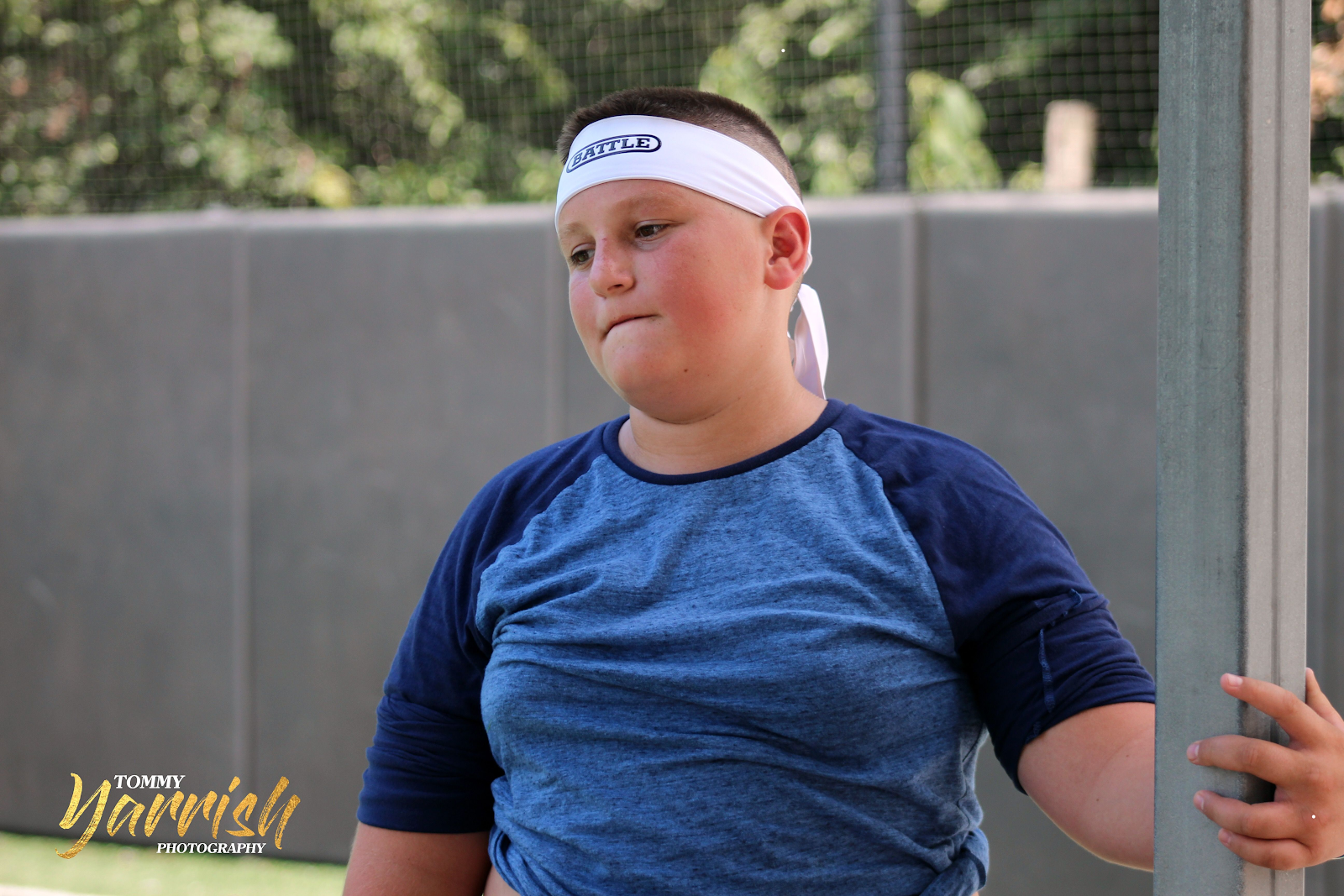


Ten-year-old Tyler Hodge peeked through the blinds that hid his new younger brother, Calder. Once he got a good look, he realized something unusual. Calder had six toes.
His family didn’t believe him, but sure enough, he had six toes on one foot and seven on the other.
It was at this window where a lifelong bond between brothers formed. Thanks to Tyler, Calder Hodge felt a bit more normal.
HIS STORY:
Before Calder was ever born, his mother, Kayla Hodge, had a normal pregnancy. Nothing out of the ordinary appeared on ultrasounds and all the prenatal tests came back normal. As his due date moved closer and closer, Calder hadn’t turned yet in his mother’s womb, which wasn’t unusual at the time either. But that all changed.
“[The doctors] didn’t really check anything, and when he was born, everybody was shocked,” Kayla said.
As soon as Calder was born on May 6, 2005, doctors immediately wrapped him up and took him away into the hall with Mike Hodge, Calder’s father. Doctors knew that something was wrong but weren’t exactly sure as to what it was, and had to run tests. From there, they went to the Newborn Intensive Care Unit (NICU) while Kayla remained in recovery.
Wanda Duncan- Kayla’s mother- and a neonatologist relayed the information back up to a worried Kayla. The doctors again said that they didn’t know what was wrong with the baby but assured her that everything was going to be all right. This didn’t change anything for Kayla, though.
“All I wanted at that point was to see Calder,” Kayla said. “I just wanted to see him.”
Calder was officially diagnosed with fibular hemimelia, a rare birth defect occurring in 1 in 40,000 births. He was missing tibia bones in both legs and had digitized thumbs, or five fingers instead of four plus an opposable thumb. Doctors were unable to come up with an explanation as to why it happened to Calder, so it was assumed that his condition boiled down to genetics.
“I really and truly don’t think that [the doctors] really know,” Kayla said.

Following his diagnosis, the Hodges tried to admit Calder into Shriners Hospital, which specializes in orthopedic conditions for children. Shriners guarantees care for the first 18 years of a patient’s life, but a doctor’s recommendation is needed for that admission to be accepted.
Once Calder was 6 weeks old, he was taken to Texas Orthopedic Hospital to see a doctor who could admit him. From there, a month already full of stress and unseen obstacles continued. The doctor began to examine Calder’s hands, much to the confusion of Kayla, and one question presented the newest set of hurdles.
“I looked at the doctor and I was like, ‘Well, don’t you need to look at his legs?” Kayla said. “The doctor looked at me very stone-cold and said, ‘Oh, they’ll amputate his legs.’”
The response came almost flippant, too informal to Kayla for something so life-shattering. It was a seemingly casual response that would lead to substantial changes for the rest of a family’s life, and this life was now hers.
And so it began.
With help from the entire family, Kayla researched different cases that were similar to Calder’s to decide whether to amputate his legs as a young child, or later in life around the age of 16. But at that time, the bottoms of his legs were not growing proportionally to the rest of his body, and his feet were clubbed so he could not sit correctly. Kayla wanted Calder to have the most normal kindergarten experience possible, so it was decided that amputations would be done immediately.
From there, extensive MRIs were done on Calder’s legs, and it was determined that he would have to be an above-knee amputee because there was nothing in his knees that would be able to help him walk normally. Finally, in July of 2007, when Calder was 2-and-a-half years old, he was finally admitted into Shriners, and the surgery was done.
“It was very standard,” Kayla said, of the amputations. “We always looked at it as that was the only surgery he would probably have to have on his legs, but we had no complications.”
After the surgery, the biggest problem for Calder was pain management. As he was only 2-years old, he wanted to crawl around and be able to move but wasn’t able to do so. His legs were tightly wrapped and bandaged at the femur and upper thigh. Eventually, the swelling went down and his legs healed after just six weeks.
Once his legs healed, the Hodges went back to the doctors to remove the stitches and begin the prosthetic process. Calder got his first pair of prosthetics the day before Halloween in 2007 and used a walker to assist him through Thanksgiving of that year, as the pair he started off with had no knee functions.

On Thanksgiving Day, he took his first steps by himself.
“We thought we would be in that situation for quite a while,” Kayla said. “But no, he moved right out of [the walker.]”
After recovering and adapting to the first pair, Calder moved into stubby prosthetic legs, which is considered the beginner level of alternative limbs. Stubby legs are short and put the subject using them very close to the ground, with a Velcro belt going around the waist to hold the legs in place.
Calder’s current legs include microprocessing knees with a suspension socket. He simply slides into a socket that acts as a suction onto his skin so it doesn’t slip off. His knee functions so he can use them whenever it’s necessary.
“There’s a small computer inside of his leg,” Kayla explained. “It has to be charged just like your phone, so we carry around chargers.”
Those chargers help his legs function in complex ways such as switching walking surfaces like concrete to gravel and being able to bend and lock when it’s necessary so Calder doesn’t fall over.

Ever since then, Calder’s been using prosthetic legs to do what he loves the most, play football. His love of sports started right from the beginning, courtesy of his brother, Tyler.
BROTHERLY LOVE
Growing up, Calder had three brothers from his father’s previous marriage: Tyler, now 24, Sheldon, now 26, and Blake, now 29. Out of all of them, Tyler has always been the closest to Calder since day one, as he was the first in the family to hold him after he was born.

“I think that’s part of why they’re so close,” Kayla said. “Because he was invested from the very beginning.”
Growing up with three older brothers, the Hodge household was an athlete’s home. All four boys were involved in sports, meaning that mini-hoop basketball games ending with a bloody nose or two weren’t uncommon. But despite the constant competition and roughhousing, Calder’s childhood years are considered his best because of everything his brothers did for him.
“If they went anywhere, they would invite me to go with them,” Calder said. “Take me to go eat, we would go to the movies … When a new superhero movie came out, we would go watch it on that same day it came out.”
While Tyler and Calder ended up being the closest of the four siblings, all of Calder’s experiences with his brothers helped him prepare for situations later in life.
“I was so blessed to have my brothers with me so that I can get ready for the real world,” Calder said. “They would give me love but also knock me down a few pegs, so it definitely got me ready for the real world.”
The key part of the siblings’ relationship was the love of sports. Fridays, Saturdays, and Sundays were all days where the Hodges would sit on the couch and watch football and baseball games. Nights like these and football games in the yard became the way that the boys bonded over time.
“It was definitely a big part in our relationship,” Calder said. “I feel like we’re close because of sports.”
Sports proved to be a way to show love and support for Calder early in his life. In 2007, Tyler’s Little League baseball team was one of the best in the country. While Tyler wasn’t playing with them, as he didn’t make the all-star cut, the team made it all the way to the regional tournament, coming up just short of a Little League World Series bid.
While it disappointed Calder that Tyler wasn’t a member of the team, it worked out as the tournament took place around the time that Calder went into surgery. At the time, all of Tyler’s teammates knew Calder and began to grow close to him. Knowing the situation at hand, they used Calder as a rallying point throughout their tournament run.
“They carried a picture of Calder to all of the games in the dugout all throughout the games,” Kayla said. “So that it could motivate the kids because they all loved him.”
As Tyler grew up, he decided to move on to playing football in the seventh grade and ended up falling in love with it in his sophomore year of high school. Tyler knew he wanted to play football at the next level, and looked to hometown heroes such as NBA star Jimmy Butler and NFL wide receiver Jordan Leslie.
When Tyler’s senior year came around his future looked bright, as he’d earned several Division II and III college football offers. In that same winter, his career ended. During a bench press workout, he felt a pop in his shoulder but shrugged it off thinking it was muscle fatigue. About a month later, an MRI showed he had torn his labrum 270 degrees, meaning that any forward motion would cause his shoulder to fall out of place.
After his injury, Tyler tried out for the football team at Blinn College in an attempt a comeback but wasn’t strong enough to earn a spot. From there, he waited five years contemplating what he wanted to do in his life, before going into the Army recruiting office on December 20, 2016.
“I told [the recruiter] I want to do something that I can be satisfied with,” Tyler said. “I want to serve my country and have a job I can be proud of.”

Six months later, Tyler fully committed to his future in the Army, and signed on September 22, the birthday of his late Peepaw.
His relationship with Calder has definitely changed over the past seven years, but he will continue to push and support his brother, knowing that he’s got to earn everything he’s working towards.
“I love Calder a whole lot and he’ll always be my little brother,” Tyler said.
FOOTBALL IS THE BEST MEDICINE
The road to professional football isn’t easy.
Add on being a double amputee, that makes things much more difficult.
But that’s not stopping Calder, it’s his driving force to better.
When three days out of his week were devoted to football and other sports at a young age, it wasn’t too hard for him to fall in love with the game. It’s become the cornerstone of his life, and everything he does off the field is only more preparation for getting onto the field.
“Football is everything in my life,” Calder said. “That’s the reason why I go to school, that’s the reason why I train so hard, that’s the reason why I do camps all summer, they’ll be the reason why I don’t get sleep.”
After a year of begging his mother, Calder finally convinced her to let him play flag football. He played in third and fourth grade and finally had his brother convince Kayla to let him play tackle football, with his reasoning being that Calder needed to learn how to take a hit.
The biggest hit he took? Middle school.
Elementary school wasn’t a problem for Calder. Kids would stare and question about his condition, but no one would really understand what was wrong. But once middle school came around, everything changed.
“Sixth grade was the worst year of my life,” Calder said.
To his classmates, Calder was like “an alien from outer space,” someone who stood out, but not necessarily in a good way. From odd looks down the hallways to being called names and laughed at, the first year of middle school was one to forget for Calder.
Thankfully, seventh and eighth grades were much less miserable, as he grew in popularity thanks to attention from the media. But even without the distraction of the media, Calder began to block out all the negative noise and only took advice from older and wiser people.
“I really only listened to my tight-knit group of friends,” Calder said. “I’ll be friendly to everybody, but if you’re my friend, you’re in that tight-knit group.”
After that tough sixth grade year, summer was a relief. But it was also time to get back to training to play the sport he loved, football.
It’s safe to say that Calder eats, sleeps, and breathes with football on his mind. After practices, he’ll talk to his teammates about what went on, and how they can improve. They’ll head to the fields together to get timings down on certain routes and sharpen every little detail to perfection.

Currently, Calder plays at Legacy the School of Sports Sciences, a private school with a curriculum designed specifically for students interested in sports administration, medicine, media, and coaching. Calder approaches everything at school like a competition, from grades to blacktop basketball games behind the school. With a school full of athletes, a competitive environment is expected, and it’s what Calder thrives in.
“It really helps me a lot with my schoolwork because I’m competing against other people,” Calder said. “Instead of just trying to get good grades, you’re trying to get better grades then the whole school.”
His first season for the Titans was a success from the start of spring football. Calder connected easily with his teammates in his first taste of high school football, working with senior defensive backs to read defenses better, and constantly making sure that he and his wide receivers were always on the same page.
Calder played on Legacy’s junior varsity team this year, throwing three touchdowns passes throughout the course of the season. But he’s not satisfied, and he knows his goal of throwing a touchdown pass on varsity is coming soon.
“It’ll be this year or next year,” Calder said.
Calder’s always gotten lots of attention from members of the media for his playing condition, but it was recently that it was taken to another level.
Last July, Calder was surprised by ABC13 reporter David Nuno with one of ESPN’s honorary ESPY awards. Calder didn’t see why he deserved it, but he did begin to notice that all of his work was finally beginning to pay off.
“Countless hours in the film room, at Blitz training on the football field after practice, all those sprints we have to run,” Calder said. “I feel like it’s all just finally paying off and I’m starting to get noticed.”
Blitz Football is where Calder trains outside of school, and where’s he’s gotten lots of his attention from. He works out a lot with Rischad “Footwork King” Whitfield, who’s trained top tier athletes such as Cleveland Browns wide receiver Odell Beckham Jr. and five-star Texas A&M wide receiver commit Demand Demas. He also regularly trains with J.P. Tillman, who works with some of the best quarterbacks all over the state of Texas. Training with some of the best has elevated Calder’s game to a level he never could’ve imagined.
“They’ve taken my game to a level I never could’ve reached on my own,” Calder said. “They’ve unlocked some things I’ve had in my all along.”
From a parent’s perspective as well, Calder’s parents have nothing but good things to say about Rischad and J.P. as they’ve adapted and treated Calder just like they would any other athlete they train.
“They are able to see beyond what’s in front of them, they see the potential that’s there and they want to unlock that potential,” Kayla said. “When [Calder] started training with Rischad, he had no idea what he was dealing with, and so he went and bought knee splints that would keep his legs locked.”
Twitter began to take more and more notice of Calder’s training videos, and because of it he was invited to go to the Detroit Lions and Houston Texans training camps. In Detroit, he threw the first touchdown pass of the day at the Lions’ practice and went viral.
Calder Hodge wants to be the first double amputee quarterback in the @NFL and today he took the first snap at @fordfield. #morethanfootball @calder_Qb7 pic.twitter.com/ZWPWCnFutd
— Detroit Lions (@Lions) August 2, 2019
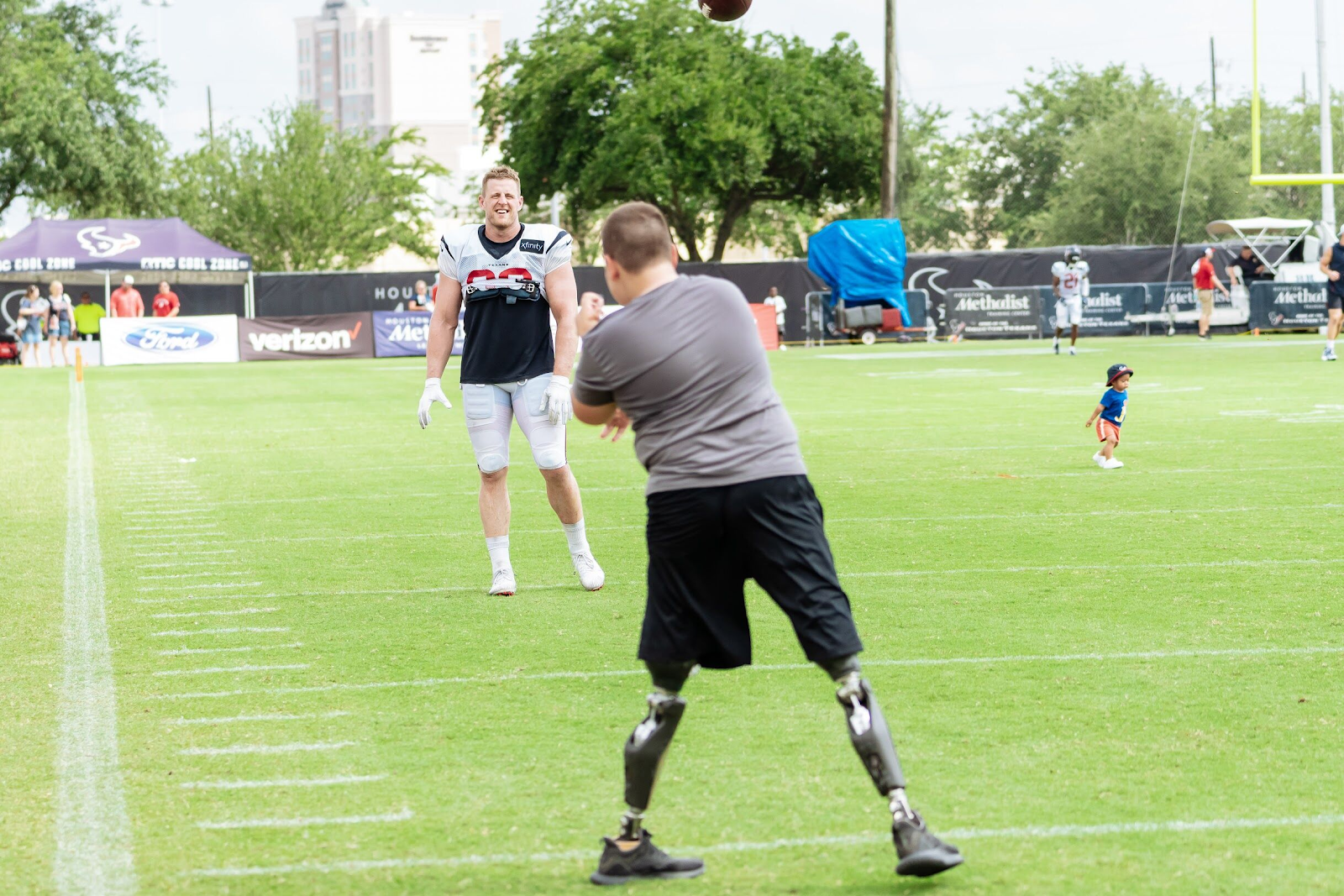
Calder received attention from star Houston Texans defensive end J.J. Watt and was later invited to their training camp as well, where he was able to meet players like J.J, wide receiver DeAndre Hopkins and quarterback DeShaun Watson.
WHAT COMES NEXT?
Calder’s freshman season may be in the books, but his potential is still sky-high. He’s talked to recruiters from Southern Illinois University and McNeese, where he’s turned some heads in a recruiting sense.
Calder is very confident in his abilities as a quarterback and holds himself to a high standard. He’s got his mindset as to where he wants to go in life, and nothing is stopping him from getting there.
“When I step on a football field, I feel my most normal,” Calder said. “I feel like I have both my legs and I’m completely normal.”